
In the name of God, the most gracious, the most merciful
Nile Bank for Trade and Development
worksheet
The role of the Nile Bank for Trade and Development in financing cotton in the irrigated and rain-fed sectors
Past, present, and future: Towards building an integrated cotton value chain
First: Executive Summary
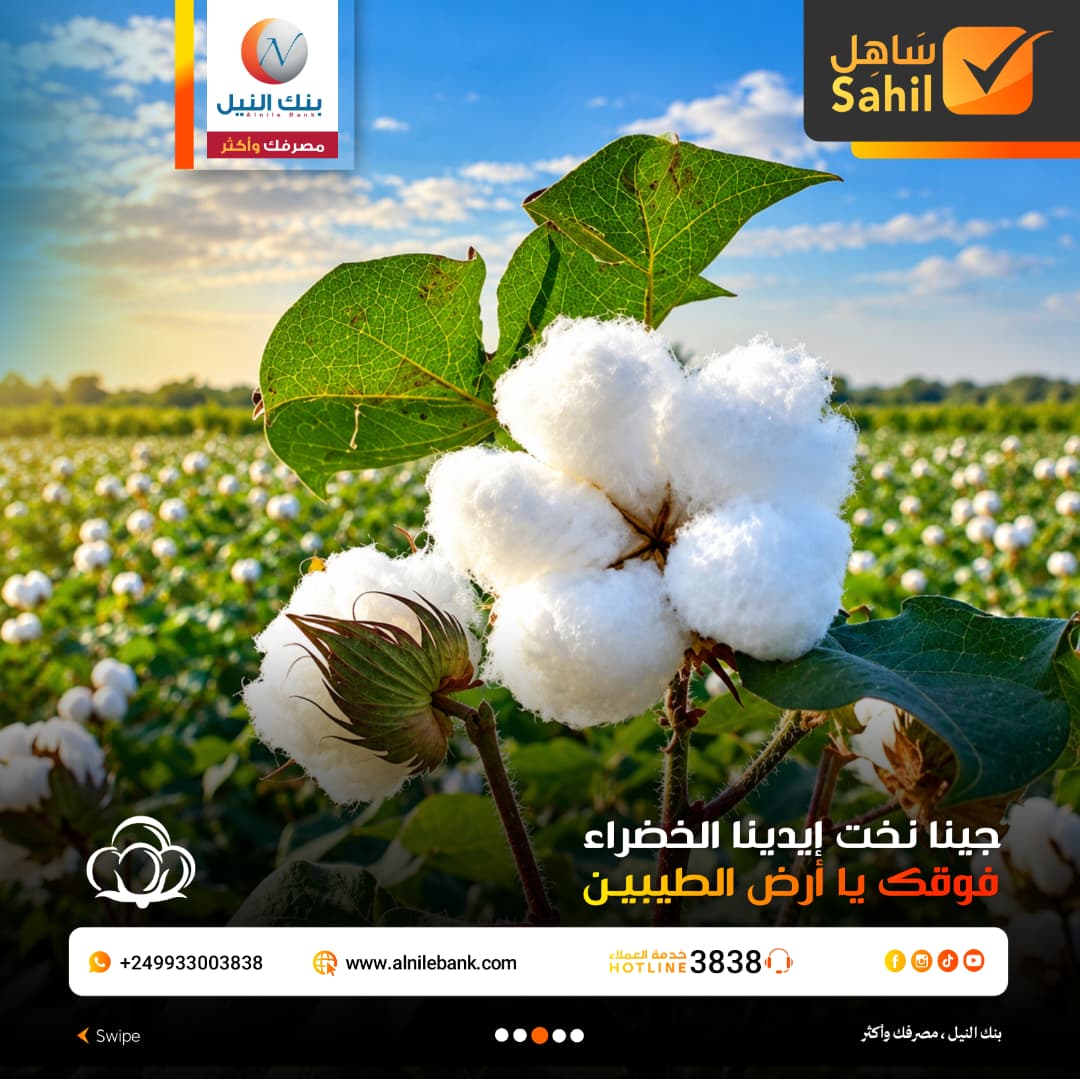
Cotton is a strategic crop in the Sudanese economy due to its economic, export, and industrial importance, and its direct link to numerous economic activities. These activities range from land preparation and agricultural inputs to production, harvesting, collection, ginning, seed and fiber extraction, and finally, manufacturing and conversion into yarns, textiles, and value-added products. Furthermore, cotton plays a significant role in generating foreign currency through exports..
The Nile Bank for Trade and Development has historically been associated with financing agricultural and productive activities, and its experience in the cotton sector has extended to a number of financing formulas and areas, including forward sales in the irrigated sector, agricultural murabaha financing for inputs in the irrigated and rain-fed sectors, cotton export financing, in addition to financing industrial and processing activities related to the sector..
The importance of this experience lies in the fact that it provides the bank with a practical basis upon which to build, moving from the concept of financing the cotton crop to a more comprehensive concept of financing the integrated cotton value chain..
This paper proposes developing the bank’s role in the future by building a tiered financing model that starts with the farmer and producer, through collection, ginning, seed and lint extraction, and finally to financing factories, production lines, spinning and weaving, while linking financing to actual production, marketing, exports, and the cash flows resulting from each stage..
Therefore, cotton can represent a strategic and integrated sector for the bank, combining agricultural financing, trade and export financing, industrial financing, and project and infrastructure financing, thereby enhancing the bank’s economic returns, supporting local production and exports, import substitution, and job creation..
Second: Introduction
Sudan possesses the natural and productive resources to regain its role in cotton production, especially given the availability of vast agricultural areas, the existence of both irrigated and rain-fed sectors, accumulated agricultural expertise, and the presence of infrastructure, institutions, factories, and previous experience in cotton cultivation, ginning, and manufacturing..
However, the economic conditions and the war that Sudan has experienced in recent years have affected production, marketing, industry, and export chains, which necessitates rebuilding a financing model capable of dealing with the new reality and combining financing, production, marketing, manufacturing, and exports..
From this perspective, it is important to review the Nile Bank for Trade and Development’s experience in cotton financing, to analyze what has been implemented previously and what is currently in place, and then to develop a future vision that enables the bank to play a greater role in rebuilding this sector..
This paper does not merely aim to increase the volume of agricultural financing, but rather to move from separate financing for each activity to integrated financing for the value chain, so that the bank becomes a financing partner in the different stages of the cotton production cycle..
Third: The importance of cotton to the national economy
The strategic importance of cottonIn the following:
- Providing foreign currency and boosting exportsThrough the export of raw and ginned cotton and manufactured products.
- Supporting the agricultural sector and increasing productivityIn both irrigated and rain-fed sectors, and to stimulate investment in cotton-related agricultural activities..
- Creating job opportunities and stimulating economic activityIn agriculture, harvesting, transportation, storage, ginning, trade, and industry.
- Maximizing added value and local manufacturingBy developing ginning, seed extraction, and utilizing cotton fibers and byproducts, and expanding the oil, feed, spinning, and weaving industries..
- Providing multiple financing and investment opportunitiesThrough the integrated value chain, enabling banks to finance production, assembly, trade, exports, and industry..
Fourth: Sectoral financing and the bank’s role in supporting the agricultural and cotton sectors
From April 2023 to the present, the Nile Bank for Trade and Development has continued to support productive sectors, primarily agriculture. Total agricultural financing disbursed reached approximately 115.57 billion Sudanese pounds, while financing directed towards cotton in both irrigated and rain-fed sectors amounted to approximately 10.687 billion Sudanese pounds, representing about 9.2% of the total financing portfolio. Despite this relatively small percentage compared to the overall portfolio, it reflects the bank’s continued commitment to directing its resources towards a strategic crop of vital importance to production, exports, and agricultural value chains. The bank’s experience in financing cotton and related activities spans several models and areas, reflecting its focus on financing all stages of the cotton value chain, as follows:
- Financing agricultural production through forward sale contracts
A.Existing experiment – Irrigated sector in New Halfa
The bank currently finances cotton cultivation using the Salam sale method in the irrigated sector of New Halfa, which allows for financing production needs before the season, and linking repayment to the harvest..
This experience provides a suitable basis for expanding cotton financing by linking financing to production, collection, and marketing..
- Previous experience – Atbara branch
The bank had previously implemented a cotton financing experiment using the Salam sale formula with the Chinese company through its Atbara branch, reflecting the possibility of employing the Salam formula in financing production linked to entities that have the ability to collect and market..
These two experiences form a foundation upon which to build in the future to develop a model.:
Bank → Product → Assembly and Marketing → Manufacturing or Export.
- Financing agricultural inputs in the irrigated sector – Al Jazirah State
The bank’s experience extended to the irrigated sector in Al-Jazirah State through agricultural Murabaha financing.:
- Gasoline and fuel.
- Other agricultural inputs.
This type of financing has contributed to supporting the production process and meeting the season’s needs in a timely manner, and represents one of the essential links in financing the cotton value chain..
- Financing agricultural inputs in the rain-fed sector – Al Qadarif State
The bank conducted financing trials in the rain-fed sector in Al-Qadarif State, which included financing:
- Operational needs for the agricultural season.
This experience represents a foundation upon which future expansion of cotton financing in the rain-fed sector can be built, taking into account the risks of rainfall, production, prices, and marketing..
- Financing cotton trade and exports
The bank’s role extended to financing cotton exports through a number of branches, including those in Khartoum and New Halfa..
This activity represents a crucial link in the value chain, as it connects finance with production and external marketing, and supports:
- Foreign trade and export operations.
- Producers and exporters.
- foreign currency inflows.
- Finance Turnover.
- Expanding the customer base in the agricultural and commercial sectors.
This will allow, in the future, for linking agricultural financing with export financing within an integrated financing system..
- Financing the cotton-related manufacturing industry
The bank’s experience also extended to industrial and processing finance through its Shendi branch, Khartoum branches, and Al Qadarif branch, thus providing a base for expanding financing in cotton value-added chains..
Target areas include:
- ginning:Establishing and upgrading cotton gins and increasing their capacity and efficiency.
- Seed extraction:Financing seed extraction lines and equipment for use in oils and animal feed.
- Hair treatment:Financing industries that benefit from hair and its derivatives.
- Manufacturing industries:Financing equipment and production lines related to cotton and its derivatives.
This axis represents a shift from financing raw agricultural products to financing added value and local manufacturing..
Summary of the bank’s experience
The Nile Bank’s experience in cotton financing can be summarized as follows::
Input financing → Production financing (Salam and Murabaha) → Collection and marketing → Export financing → Ginning → Seed and lint extraction → Manufacturing and processing.
This development provides the bank with a practical basis for moving in the next phase to financing the integrated cotton value chain, combining agricultural, industrial, commercial and export financing..
Fifth: Evaluating past and present experience
The evolution of the bank’s role in cotton financing can be summarized in four main stages.:
Stage | Activity | Formula/Tool |
First | financing agricultural production | Peace sale |
Second | financing agricultural inputs | Murabaha |
Third | Trade and export finance | Export Finance/Trade |
Fourth | Industrial and transformational finance | Murabaha/Asset and Production Line Financing |
This development indicates that the bank already possesses the essential components that enable it to move to a more comprehensive phase, namely financing the integrated cotton value chain..
Sixth: Challenges and risks
Despite the significant opportunities, cotton financing requires careful risk management, the most prominent of which are:
- Production risks
- Rainfall fluctuations in the rainy sector.
- agricultural pests.
- High input costs.
- fuel shortage.
- Weak agricultural services in some areas.
- Price risks
Fluctuations in global and local cotton prices can affect customers’ ability to pay..
- Marketing risks
Weak marketing channels or delayed deliveries may lead to a delay in capital turnover..
- Export risks
It relates to foreign markets, exchange rates, foreign trade procedures, and risks associated with buyers..
- Industry risks
High cost of setting up production lines, supplying spare parts and energy, and operational difficulties in some areas.
- Security and logistical risks
Current conditions necessitate a study of the project site, asset safety, and transportation and storage routes.
- Storage risks
Seventh: Proposal to establish a “Cotton Financing Portfolio”“
The paper suggests studying the creation of a specialized portfolio for financing the cotton value chain within the bank, not to be viewed solely as an agricultural portfolio, but rather as a multi-sector portfolio that includes:
Agriculture + Trade + Exports + Industry + Productive Infrastructure.
The portfolio is in charge:
- Identifying targeted sectors and regions.
- Preparing appropriate financing products for each stage.
- Coordination between agricultural finance departments, companies, institutions, and foreign trade.
- Preparing a list of priority clients and projects.
- Season monitoring, production, and marketing.
- Linking financing to cash flows.
- Measure return and risk periodically.
- Building a historical database of cotton customers.
Eighth: Proposed Geographical Expansion
Expansion can be based on areas where the bank has existing experience and relationships, especially:
Irrigated sector
- New Halfa.
- Al Jazeera State.
- Other irrigated agricultural areas and projects.
Rainy sector
- Al Qadarif State.
- Other promising rainy regions.
Commercial and industrial centers
- Al Qadarif.
- New Halfa.
Expansion is carried out according to economic and security feasibility, the availability of infrastructure, and the ability to monitor progress..
Ninth: Expected economic and social impact
Expanding financing for the cotton value chain can contribute to:
- Increase in cultivated areas.
- Increase productivity.
- Providing direct and indirect job opportunities.
- Support for small and medium-sized producers.
- Restarting factories.
- Increasing the production capacity of cotton gins.
- Increasing the percentage of local manufacturing.
- Increase in export revenue.
- Providing foreign currency.
- Reduce exports of raw materials and increase exports of value-added products..
- Supporting small and medium industries.
- Activating transport and logistics services.
- Contributing to economic recovery and reconstruction.
Recommendations:
In light of the above, the paper recommends the following::
- Adopting the cotton value chain as a strategic sector for financingWithin the bank’s agricultural, industrial and commercial strategy.
- Creating a specialized cotton financing portfolioIt includes both irrigated and rain-fed sectors, and covers various stages of production and marketing..
- Developing specialized financing productsTo finance agricultural inputs, finance production through a forward sale agreement, and link financing to the stages of implementation, production, and marketing..
- Boosting cotton trade and export financingLinking it to producers, assemblers, and factories, which supports foreign currency flows and the circulation of finance..
- Expanding financing for the cotton processing industryEspecially cotton gins, seed and oil extraction, animal feed, hair processing, production lines and industrial equipment.
- Future expansion in financing spinning, weaving, and value-added industriesThis will achieve a shift from exporting raw materials to maximizing local added value and import substitution..
- Establishing an integrated system for managing the risks and financing of the cotton supply chainThis includes a customer database, field follow-up, feasibility studies, coordination between agricultural finance departments, companies, trade and exports, and encouraging partnerships with producers, investors, and industrial and commercial entities..
Conclusion:
The experience of the Nile Bank for Trade and Development has proven that it possesses accumulated expertise in financing cotton, from inputs and production through Salam and Murabaha, to marketing and export, and then industrial and processing activities..
This experience provides a basis for transitioning from financing agricultural activity to financing the integrated cotton value chain, including ginning, seed and lint extraction, processing industries, spinning, weaving and exporting..
In this way, the bank can transform into an integrated financing and development partner in the cotton sector, contributing to increased production, added value, and exports, providing job opportunities, and supporting economic recovery..
Proposed vision:
To become one of the leading banks in financing the integrated cotton value chain in Sudan, from inputs and production to manufacturing, spinning, weaving and export, thereby achieving added value for the national economy and a sustainable return for the bank..
And with God’s help, success will be achieved.
Nile Bank for Trade and Development
Corporate Finance Department